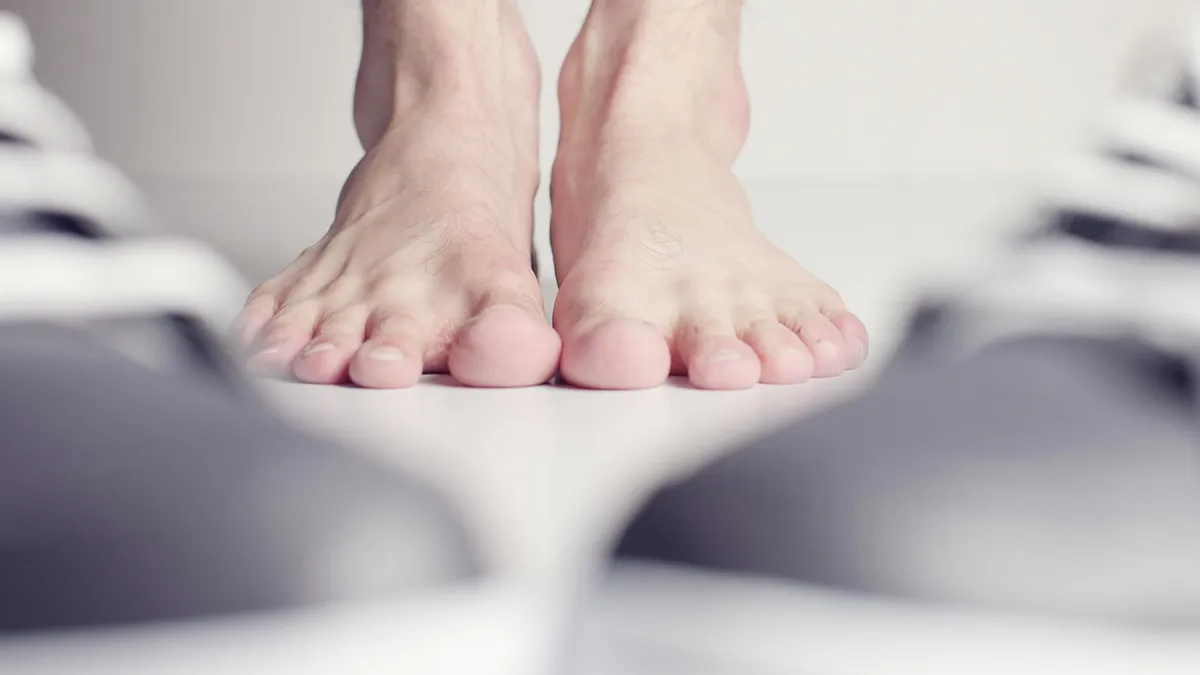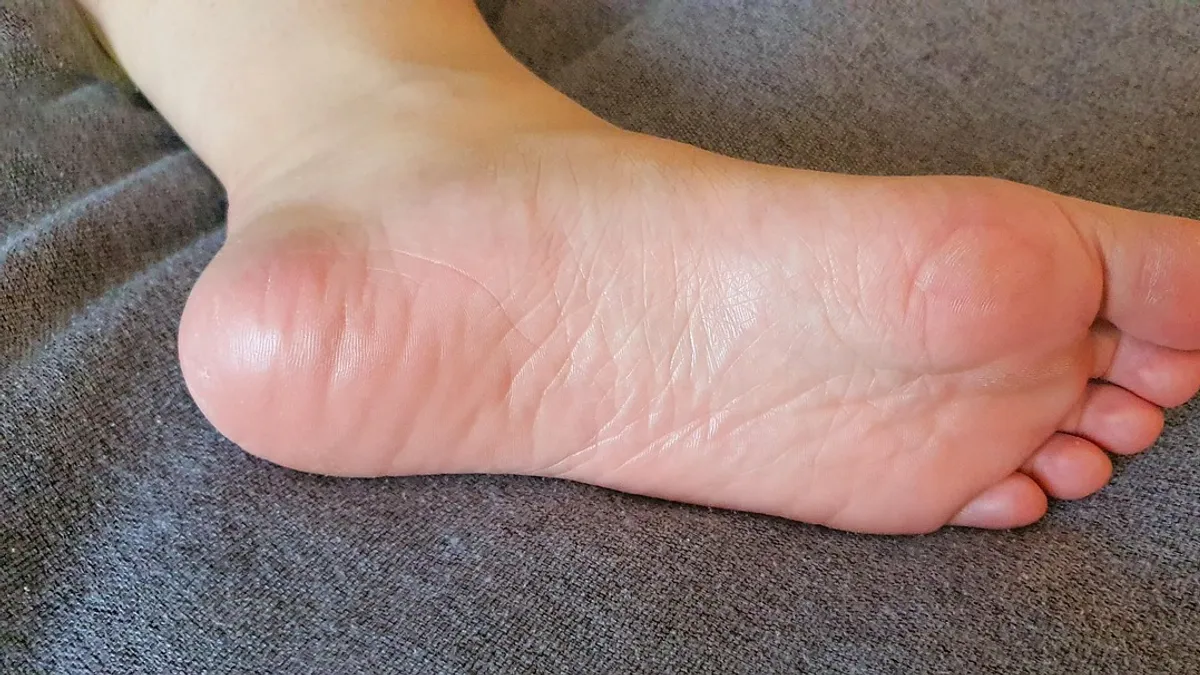
A wide toe box — a toe area as wide as your splayed foot, not a tapered point — matters because your toes do real work with every step: they spread to widen your base of support, help you balance, and push off the ground. Narrow shoes stop that work and over years push your big toe inward, the pattern behind bunions, hammertoes and forefoot pain. You can measure your feet at home in five minutes with paper, a wall and a ruler — and once you know your numbers, buying shoes with real toe room becomes simple.
Key Takeaways
- Toe splay is functional, not cosmetic. Your toes spread with every step to widen your base of support, spread weight across the forefoot and let the big toe push off straight.
- Narrow toe boxes are the problem. A tapered toe box rotates the big toe inward over years — the mechanism behind bunions — and lets the foot muscles that hold your arch up go quiet.
- Measure in the evening, standing, in millimetres, both feet. Feet swell 5-10mm over a day in Malaysia’s heat, and your two feet are not the same size.
- Leave ~10mm ahead of the longest toe and use the trace test on any shoe: it must be wider at the forefoot than your traced foot.
- Real catalog prices, checked 2026-09-20: wide-toe-box Saguaro models run from RM84 (Women Touch 4) through bestsellers like the Men Vitality 3 at RM221 and Luck 1 at RM238.
What a “wide toe box” actually is
Look at the sole of a typical shoe. The forefoot tapers toward the toe — some dress shoes taper almost to a knife edge, but even a “normal” sneaker narrows from the ball of your foot forward. A wide toe box is simply a toe area that does not taper in: the shoe follows the outline of a foot with toes spread, so your toes sit in their natural splayed position instead of being squeezed together.
Don’t confuse it with a wide fitting (more volume across the whole foot, including the midfoot and heel). A shoe can have a wide toe box and still hold you snugly at the heel — splay room up front, secure hold at the back — which is exactly what good barefoot shoes aim for. Brands like Saguaro build lasts that are foot-shaped rather than fashion-shaped, which is why “wide toe box” and “minimalist shoe” so often appear together.
Why width actually matters
Your toes are not decoration. Go barefoot and watch your foot as you shift weight: the toes spread apart and press down. That spread does three jobs:
- Balance. A splayed foot is a wider base of support. Stand on one foot barefoot, then squeeze your toes together — the wobble tells you what narrow shoes do to your balance daily.
- Load spreading. The forefoot has five metatarsal heads to carry weight. In a tapered toe box the middle ones take most of the load and the big toe gets pushed inward — the mechanism behind pain at the ball of the foot.
- Push-off. Your big toe is the last thing to leave the ground when you walk. It can only push in a straight line if it lies straight; a shoe that angles it toward the second toe turns every step into an inefficient, joint-stressing push.
The long-term story is the bunion: years of a big toe held at an angle gradually rotate the joint at its base outward. Not everyone who wears narrow shoes gets bunions — genetics matter — but the pressure is real and preventable. The same squeeze is why the small muscles between the toes weaken over decades: they never get to do their spreading job, so they wither like any unused muscle.
None of this means narrow shoes are evil. It means the toe box is a genuine health variable — and the cheapest one to fix: a wide-toe-box shoe starts at RM84 in the live catalog, and going barefoot at home costs nothing.
How to measure your feet at home
Five minutes, a wall, paper, a pencil and a ruler. Do it in the evening — Malaysian heat and a day on your feet swell them by 5-10mm, and you want to size for your biggest foot.
Step 1: Trace. Tape paper to the floor against a wall. Sit with one foot on the paper, heel touching the wall, then stand so your weight is on that foot (the foot spreads under load). Hold the pencil vertical and trace all the way around — tilt it inward and you will draw a smaller foot.
Step 2: Mark. Draw three lines with a ruler:
- Length: heel line to tip of the longest toe (often the second toe, not the big one).
- Width: across the widest part — the ball of the foot, just behind the toes.
- Heel width: across the heel, to check the shoe will hold you at the back.
Step 3: Measure in millimetres. Brand size charts speak mm, not inches. Note both numbers for both feet — they will differ, sometimes by 5mm or more.
Step 4: Use the larger foot. Size for the bigger foot and the wider forefoot. A shoe can be snug in the heel; it cannot be stretched wider at the toe.
Reading your numbers
Your length in mm meets the brand’s size chart. The full cross-brand breakdown is in our Malaysian sizing guide; to anchor roughly, a 260mm foot is an EU 42 — and Saguaro runs wide and forgiving compared with Vivobarefoot (narrow) or Xero (true to size with a wider forefoot).
Your width in mm is the number nobody teaches you to use. A useful reference: most standard-width shoes assume a forefoot width of roughly 38-42% of foot length. Compute yours — width ÷ length. At about 42% or higher, you have a genuinely wide forefoot and should seek brands known for wide toe boxes.
Finally, the thumb rule: standing in the shoe, allow roughly 10mm (about a thumb’s width) of space ahead of your longest toe, and your toes should be able to wiggle without pressing the edge. If your little toe touches the side of the toe box, the shoe is too narrow whatever the size number says.
The trace test for any shoe
The most useful check when a pair arrives: trace the insole (or print the brand’s size chart), place your traced foot on top, and compare. The shoe outline should be wider at the forefoot than your foot — never narrower. This catches the classic mistake of buying by length only: a shoe can be long enough in mm and still crush your toes sideways.
What wide-toe-box shoes cost in Malaysia
All prices below are from the live Bearfoot Malaysia catalog (checked 20 September 2026, USD-MYR at 4.0805). The catalog covers 114 products, and Saguaro’s lasts are consistently the widest of the major barefoot brands — a safe default for Malaysian feet.
Budget: Women Touch 4 — RM84 (on sale from RM113), the cheapest pair in the catalog and the cheapest way to test toe splay.
Mid-range bestsellers: Men Vitality 3 at RM221, Women Smart 2 at RM221, Luck 1 at RM238 — all with the same wide, forgiving last.
Lighter mesh for KL heat: Breeze 1 — RM167 (on sale from RM275), breathable mesh, drying fast after a downpour.
Prices are indicative and checked periodically — confirm on the product page or saguaro.com before buying. Start at the budget end: the point is what your feet tell you, not the price tag. Use code SUBIMPACT at saguaro.com checkout for 10% off.
A note for parents: kids need this most
Children’s feet are still forming, and their toe boxes should never be tapered — yet kids’ shoes often are. The good news: wide-toe-box kids’ shoes are cheap in the catalog — Kid Dive 3 at RM146 (on sale from RM184), Kid Agile 1 at RM150 (on sale from RM196), bestseller Kid Vitality 3 at RM204. Our kids’ guide covers when to start.
The honest bottom line
- Wide toe boxes matter for everyone, because toe splay is part of how feet are supposed to work — not a luxury for wide-footed people.
- Measure your feet once, properly — length and width in mm, both feet, evening. Five minutes, no more guesswork.
- Run the trace test on every pair before you commit, and allow ~10mm ahead of the longest toe.
- You do not need expensive shoes to get toe room. The live catalog starts at RM84, and the same wide-toe-box construction carries through to the bestsellers at RM221-238.
For how each brand’s toe box behaves — Saguaro vs Vivobarefoot vs Xero vs local brands — see the sizing guide, and browse the shop for live MYR prices.
FAQ
Why do wide toe boxes matter?
Your toes spread with every step to widen your base of support, spread weight across the forefoot and let the big toe push off in a straight line — and a wide toe box is the only shoe design that allows it. Squeezed toes push the big toe inward and narrow that base, which is the pattern behind bunions, hammertoes and forefoot pain.
How do I measure my feet at home for wide toe box shoes?
Trace both feet on paper against a wall, standing with your weight on the foot being traced and a pencil held vertical. Mark the longest toe, the widest points of the forefoot and the heel, then measure length and width in millimetres. Do it in the evening — feet swell in Malaysia’s heat — measure both feet because they differ, use the larger foot for sizing, and leave about 10mm ahead of the longest toe.
What should my foot width be relative to my foot length?
There is no single correct ratio, but a useful reference: most standard-width shoes assume a forefoot width of roughly 38 to 42 percent of foot length. If your measured forefoot width is about 42 percent or more of your foot length, you have a wide forefoot by most brands’ sizing and should look for shoes with a genuinely wide toe box.
Which barefoot shoe brands have the widest toe boxes?
Saguaro is the most consistently wide and forgiving across its catalog, Xero offers wide options on many models, and Freet is described as very generous. Vivobarefoot is the narrow one — people between sizes should size up. The reliable check for any pair is the trace test: if the shoe narrows before your toes finish spreading, it is not wide enough.