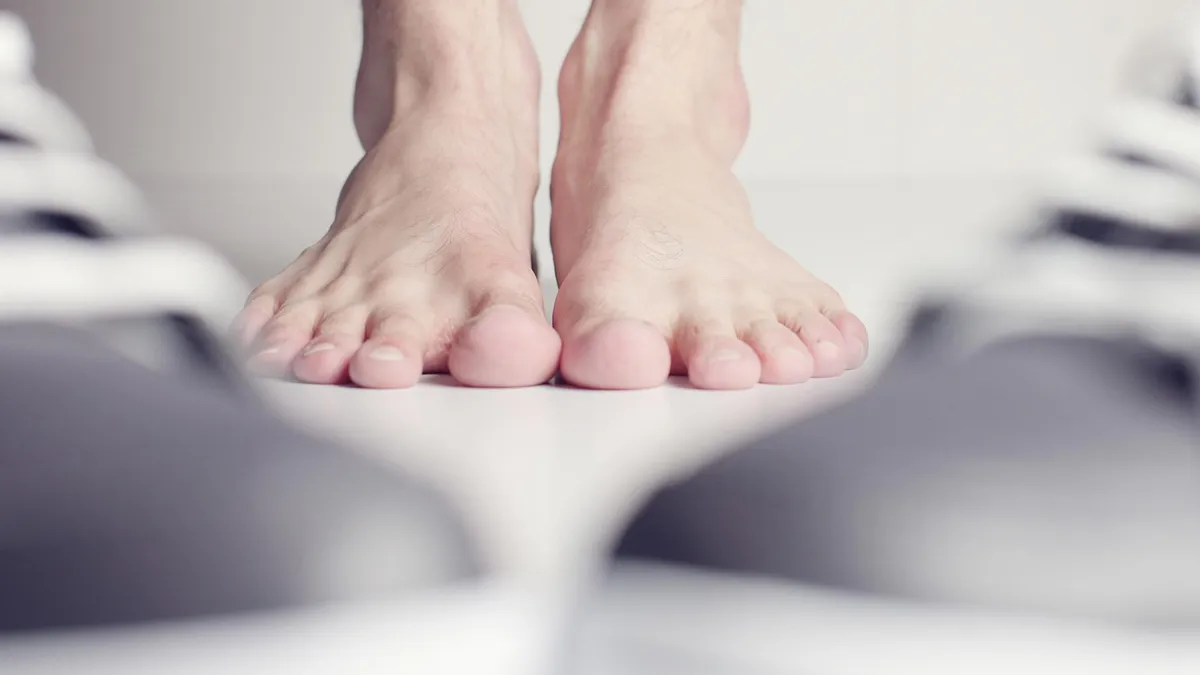
A wide toe box is an anatomically shaped footwear forefoot that allows the metatarsals and toes to spread naturally under gravitational load, preserving the foot’s structural integrity. Conventional tapered shoes force the great toe into valgus deviation, compromising the plantar fascia and balance. Accurately measuring foot length and width ensures proper sizing, preventing nerve compression and progressive foot deformities.
Key Takeaways
-
Natural Splay Activates the Windlass Mechanism: Permitting the hallux to maintain a straight vector stabilizes the medial longitudinal arch and optimizes kinetic load distribution across the lower extremities.
-
Tropical Climate Expands Foot Volume: High ambient heat and humidity across Malaysia cause daytime peripheral vasodilation, requiring 8 to 12 millimeters of forefoot length allowance.
-
Asian Anatomy Requires Wider Forefoot Lasts: Malaysian feet frequently feature wider forefoot-to-heel ratios and flexible arch structures that suffer severe nerve compression in standard Western narrow lasts.
-
Real Malaysian Landed Costs Vary Substantially: Accessible zero-drop brands like Saguaro (RM84 to RM237) deliver genuine anatomical toe freedom at a fraction of imported options like Vivobarefoot (RM560 to RM1,020).
-
Standardized Millimeter Measurement Eliminates Returns: Measuring weight-bearing feet in the late afternoon prevents costly international return shipping when ordering minimalist shoes online.
The Biomechanics of Wide Toe Boxes: Restoring Forefoot Splay and Arch Function
Restoring natural forefoot splay through an anatomically wide toe box stabilizes the medial longitudinal arch by engaging the windlass mechanism of the plantar fascia without external artificial support.
The human foot is an intricate architectural structure comprising 26 bones, 33 joints, and over 100 muscles, tendons, and ligaments. In an unconstrained state, the human forefoot is naturally wider than the rearfoot, forming a dynamic triangular base of support across the calcaneus, the first metatarsal head, and the fifth metatarsal head. During the midstance and propulsion phases of human locomotion, the digits expand laterally to absorb kinetic impact and stabilize the body over uneven terrain.
The Hallux, Plantar Fascia Mechanics, and the Windlass Mechanism
The hallux (great toe) serves as the primary directional anchor and propulsion lever of the human lower body. Under uninhibited movement mechanics, extension of the hallux tightens the plantar aponeurosis around the metatarsophalangeal (MTP) joints—a mechanical principle known as the windlass mechanism. This mechanical tension shortens the distance between the calcaneus and the ball of the foot, naturally elevating the medial longitudinal arch and transforming the foot from a compliant shock absorber into a rigid, energy-efficient lever for push-off.
Conventional footwear with pointed or tapered toe boxes forces the hallux inward toward the second digit, establishing the structural deformity known as hallux valgus (bunions). When the great toe is deviated medially, the abductor hallucis muscle is placed under chronic passive stretch, rendering it incapable of stabilizing the first metatarsal. Consequently, the windlass mechanism fails to engage efficiently, causing the medial arch to collapse inward (overpronation) and transferring excessive shear forces onto the second and third metatarsal heads, which frequently manifests as metatarsalgia, Morton’s neuroma, and compensatory Achilles tendon strain.
Asian Foot Morphology and Malaysian Population Specifics
Foot dimensions are genetically and regionally variable. Anthropometric studies evaluating Southeast Asian populations consistently identify distinct morphological traits when compared to standard Caucasian footwear models: a wider forefoot relative to total foot length, a broader ball-to-heel ratio, and a higher prevalence of flexible flat feet. Despite these anatomical realities, the vast majority of shoes sold in Malaysian commercial centers are built around Western “D” (men’s) or “B” (women’s) medium lasts that aggressively taper inward precisely where Asian feet require maximum volume.
When an anatomically wide foot is forced into a restrictive, tapered shoe, the transverse metatarsal arch is physically compressed. This lateral impingement pinches the interdigital plantar nerves against the transverse metatarsal ligaments, leading to chronic numbness, tingling, and local ischemia. Transitioning to a wide toe box allows the transverse arch to expand, restoring full capillary circulation and peripheral nerve function across all five toes.
Minimalist Footwear Landscape in Malaysia: Brands, Sizing, and Real Landed Costs
When purchasing minimalist footwear in Malaysia, accounting for import duties, sales taxes, and currency fluctuations reveals that budget-friendly brands like Saguaro offer comparable anatomical foot protection at one-third the landed cost of imported legacy brands.
Selecting minimalist footwear in Malaysia requires a clear assessment of landed costs. Because wide-toe-box shoes remain underrepresented in conventional brick-and-mortar storefronts, Malaysian consumers frequently rely on cross-border logistics. With international currency exchange hovering near USD 1 to MYR 4.0915, combined with air freight charges and local Sales and Service Tax (SST), Western heritage brands come at a substantial financial premium. Vivobarefoot, imported directly from the United Kingdom, commands landed retail costs ranging from RM560 to RM1,020 per pair. Similarly, American import Xero Shoes reliably lands between RM380 and RM660 once shipping and customs processing are settled.
Locally, Atlas Originals offers domestically fulfilled barefoot-inspired gym footwear priced from RM150 to RM250, catering primarily to strength athletes. For daily lifestyle wear, trail walking, and road running, Saguaro provides an accessible entry point with consistent local availability. Saguaro’s accessible models, such as the Women Touch 4, range from RM84 during promotional sales up to RM113 standard retail. Their flagship high-durability bestsellers—including the Women Smart 2, Men Vitality 3, and Luck 1—retail stably between RM221 and RM237. Readers navigating their first barefoot transition can apply the discount code SUBIMPACT at checkout on Saguaro’s official storefront to secure an additional 10% off their purchase.
Tropical Climate Realities: Heat, Humidity, and Moisture Drainage
Footwear performance in urban environments like Kuala Lumpur, Petaling Jaya, and George Town cannot be separated from equatorial weather conditions. Year-round ambient temperatures between 31°C and 34°C, paired with relative humidity exceeding 80%, accelerate perspiration. Narrow shoes trap moisture between compressed, overlapping toes, fostering macerated skin and fungal infections such as tinea pedis. A wide toe box enables active air circulation and physical separation of the digits, which curtails bacterial proliferation and foot odor.
Additionally, Malaysian roads and pavements regularly alternate between intense radiant surface heat—frequently exceeding 50°C on exposed asphalt—and sudden afternoon convective flash floods. Footwear must balance thermal protection against rapid drainage. Saguaro models feature quick-drying elastic mesh uppers that rapidly expel water after torrential downpours, anchored by zero-drop vulcanized rubber outsoles that shield the plantar surface from asphalt heat while preserving ground proprioception.
  Brand & Model
  Toe Box Profile
  Upper & Climate Suitability
  Malaysian Landed Price (MYR)


  **Saguaro Touch 4**
  Anatomically Wide
  Ultralight, quick-dry elastic mesh; high breathability for hot days
  RM84 (sale) – RM113


  **Saguaro Smart 2 / Vitality 3 / Luck 1**
  Anatomically Wide
  Reinforced drainage mesh, durable zero-drop rubber outsole
  RM221 – RM237 (Use code **SUBIMPACT** for 10% off)


  **Atlas Originals Barefoot**
  Wide
  Canvas and synthetic leather; optimized for powerlifting and gym sessions
  RM150 – RM250 (Local ready stock)


  **Xero Shoes (Prio / HFS)**
  Wide
  Standard technical running mesh; moderate water retention in heavy rain
  RM380 – RM660 (US Import + Freight)


  **Vivobarefoot (Primus Lite)**
  Anatomical Wide
  Recycled performance mesh; minimal thermal insulation from hot asphalt
  RM560 – RM1,020 (UK Import + SST)
How to Accurately Measure Your Feet at Home: A Tropical Protocol
To accommodate heat-induced fluid expansion and weight-bearing forefoot splay in Malaysia’s tropical climate, foot measurements must be taken while standing at the end of the day with an additional 8 to 12 millimeters added to raw foot length.
Because minimalist lasts rely on internal volume rather than compressive foam overlays to seat the foot, guessing your size based on conventional running shoes inevitably leads to sizing errors. Follow this laboratory-grade protocol at home using basic metric tools.
Step-by-Step Measurement Protocol
-
Step 1: Timing and Physiological Expansion. Take your measurements between 4:30 PM and 7:00 PM. Tropical ambient heat induces peripheral vasodilation, while prolonged gravity causes fluid pooling in the lower extremities, expanding total foot volume by up to 5% compared to early morning measurements.
-
Step 2: Surface Selection. Place an A4 or A3 sheet of plain paper on an uncarpeted, rigid floor surface—such as ceramic tile, vinyl plank, or polished concrete—directly flush against a true perpendicular wall or skirting board.
-
Step 3: Weight-Bearing Positioning. Step onto the paper barefoot with your calcaneus (heel bone) lightly touching the wall. Stand tall with your body weight distributed equally across both feet. An unweighted, seated foot measures significantly shorter and narrower than a foot bearing full body mass.
-
Step 4: Vertical Perimeter Tracing. Using a mechanical pencil held perpendicular (strictly 90 degrees) to the floor, mark the outermost tip of your longest toe. Note that for individuals exhibiting Morton’s foot morphology, the second toe extends past the hallux. Next, mark the widest points across the first and fifth metatarsal heads (the ball of the foot).
-
Step 5: Metric Measurement. Step off the paper and use a rigid steel ruler to measure the distance from the edge of the paper to the longest toe mark in millimeters (Length), and the distance between the two widest lateral marks (Width). Repeat this process for both feet, and retain the larger values.
The Functional Clearance Rule and Muscular Adaptation
Never purchase a shoe whose internal dimensions match your raw foot length. During the gait cycle, the foot dynamically lengthens by 3 to 6 millimeters under load, while the toes require forward clearance to prevent striking the toe box during downward inclines. Always add 8 to 12 millimeters (10 millimeters is the gold standard for broader Asian feet) to your raw millimeter length before cross-referencing brand sizing charts.
When transitioning from elevated modern footwear (which commonly features an 8 to 12 mm heel-to-toe drop) to flat, wide-toe-box shoes, the Achilles tendon and triceps surae (gastrocnemius and soleus) are placed under unfamiliar eccentric tension. Avoid transitioning abruptly. Wear your wide-toe-box shoes for 60 to 90 minutes per day during routine errands or light office walking, progressively increasing wear time over 6 to 8 weeks to allow connective tissues and the intrinsic foot musculature to readapt safely.
Frequently Asked Questions
How much extra space should I leave in the toe box of a barefoot shoe?
You should maintain between 8 and 12 millimeters of clear space between your longest toe and the shoe interior. This functional buffer accommodates dynamic foot elongation during the push-off phase and prevents repetitive microtrauma to toenails and metatarsal joints during daily walking.
Why do my feet swell more when wearing minimalist shoes in Malaysia?
Feet naturally expand in Malaysia due to heat-induced vasodilation and gravity. When transitioning to zero-drop footwear, increased blood flow to previously dormant intrinsic foot muscles temporarily increases fluid perfusion during initial adaptation weeks, amplifying normal tropical swelling before muscular tone stabilizes.
Can wearing wide toe box shoes correct existing bunions?
Wide toe boxes relieve pressure on the first metatarsophalangeal joint and halt bunion progression by allowing the hallux to align naturally. While severe bony structural deformities require medical intervention, soft tissue alignment, joint mobility, and inflammatory pain improve significantly once shoe-induced constriction is eliminated.